Just as the sentence is the smallest unit of spoken or written language that conveys a complete spoken or textual thought, the single photograph is the smallest unit of photographic language that conveys a complete visual thought.
Consider the following sentence:
The car is red.
This is a complete thought – it contains a subject (a person place or thing) – “car”, a verb (action or state of being) -- “is” and, in this case, an attribute (a condition, quality or feature as a characteristic of the subject) – “red”. It is also marked by a “terminal punctuation” (a period) signifying the end of the sentence. In decoding this sentence, we read each word in sequence from left to right. At the end of the sentence we know there is some kind of car and that it is red. And most importantly, that is all we know. We know nothing of its age, make, model, location, etc. We have no context for the car.
Consider the photograph below:
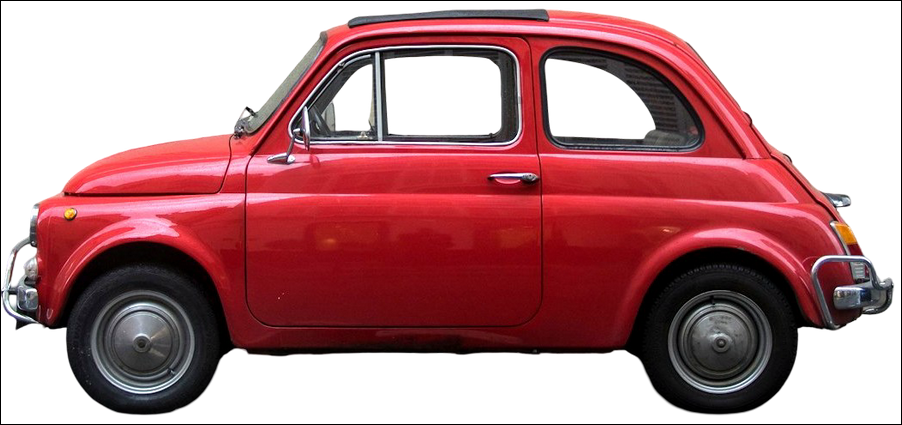
This is the photographic version of the sentence above and it contains all of the information in that sentence. The photograph communicates the same central proposition as the sentence: there is a car, and it is red. Unlike the sentence, however, it also carries additional visual information that the text did not explicitly encode. We see it is a “smaller” car and it is most likely “older”. Beyond that, the photograph tells us nothing else.
But here is the difference – instead of “reading” sequentially to get the information, we apprehend the car, its color and the lack of context instantly and simultaneously.
Generally speaking, we have more information in a complete photograph than just the cut-out of the subject against a blank background. We generally have at least both foreground and background elements.
Consider the photograph below:
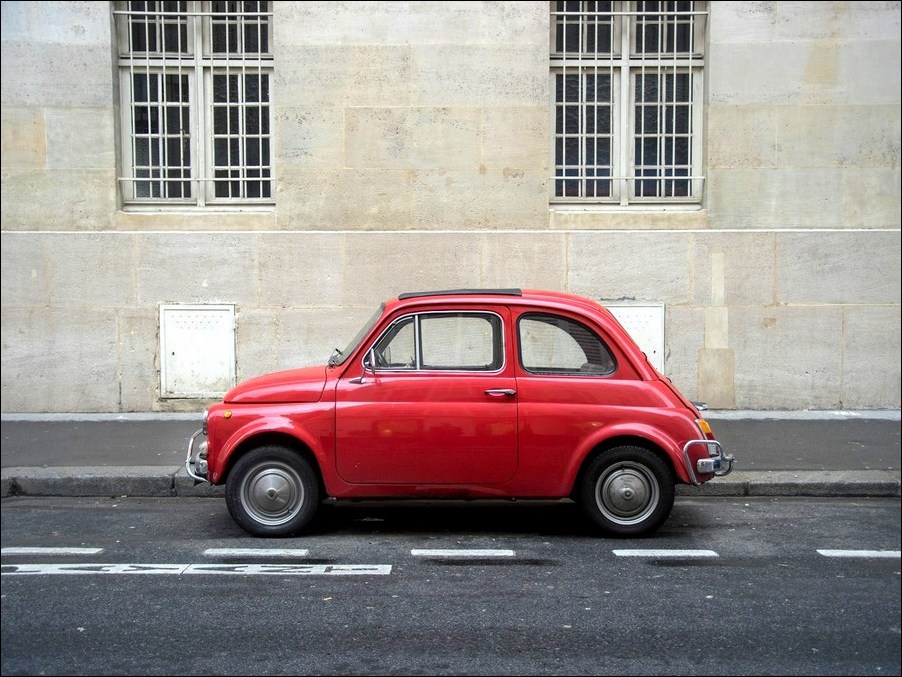
We see the same red car as above with all the same attributes but here it is parked by what appears to be the curb of a side street in front of a granite block wall with two barred windows and two small access ports. The curb is separated from the wall by what appears to be a sidewalk. While we have a context for the “red car” this is all we know.
And, again, this photograph is a complete thought.
Now, consider this photograph:

This is a far more visually complex and layered photograph with medical professionals in a surgical theater operating on a patient. We have all the context we need to make this association. The individuals are dressed appropriately and paying attention to the activity depicted, the instruments and assistive technology are appropriate to the scene, lighting appears to be consistent with the scene, etc. Beyond that, the photograph tells us nothing.
In all fairness, the active visual scanning of this photograph is not as instantaneous as with the parked car, but the net effect is still apprehension of the scene “in the blink of an eye”.
Consider this third and final photograph:

This photograph, in which the photographer used a “leading line” composition technique rising from the left midpoint of the frame to the upper right, appears to be a portrait of a family group with “Dad” anchoring the line to the left and slightly below and “Mom” anchoring the line to the right, slightly above. “Junior” and “Sis” fill in the space between “Dad” and “Mom”. The setting appears to be either a rural area or a park based on the obviously large log used as posing prop and the background.
Again, the photograph is a bit more layered and complex but apprehension is almost immediate. Anything beyond those observations remains outside the frame.
All of these photographs give us, the readers, a complete thought but they do not give us anything close to a complete story or even a portion of the complete story.
The single photograph is, at best, a story fragment.
A single photograph rarely tells the subject's complete story. Instead, it records one communicative act. The photographer has recognized something meaningful and encoded that meaning through the relationships among the elements within the frame.
In effect, every successful photograph asks a question:
What's the story here?
The viewer's task is to decode those visual relationships and recover the meaning the photographer perceived.
But this analysis applies only to the scene contained within the frame. Once we begin asking what is missing from the subject's story, we move beyond the single photograph and toward visual narrative.
When we break the concept of the single photograph down there are four principles to remember beyond the standard considerations of composition, exposure, processing, etc.
1. The single photograph is always a slice of time. Whether the exposure lasted 1/6572 of a second or 137 minutes, every photograph documents a slice of time. Whether it is rush-hour traffic on the interstate from the overpass bridge or the constellations above us, it is a slice of time.
2. The single photograph is always the slice of a larger story. The single photograph is always only one element of a story that started before the photograph was taken and will continue after the photograph was taken. The third inning of the baseball game is not like the second inning was or what the fourth inning will be. The story extends on both sides of the photograph.
3. The single photograph is always a selective framing of reality. Not that it changes the reality of the scene but that it isolates certain elements within the larger reality and presents them as a complete thought with nothing outside frame visually impinging upon those elements.
4. Although the single photograph presents itself as a complete visual thought, it inevitably leaves portions of the larger narrative unresolved. In this, multiple photographs around the same subject build more complex and complete narratives leading to essays and documentary projects.
These expanded projects often lead the reader from apprehension of meaning based on the photograph’s content to comprehension of the subject’s story based on the storytelling in the larger, more extensive photographic essay.
All of the articles on this website are contained in the downloadable white paper "Operationalizing the Language of Photography for Effective Storytelling". To download the paper, click here.